
Programs
AIME Clinical Cadaver
Develop the skills and judgment required for safe, effective airway management in critical care settings. Our programs offer advanced, hands-on education designed to strengthen clinical decision-making in airway emergencies.
Learn, do, repeat.
For more than two decades, the Airway Interventions & Management in Emergencies (AIME) programs have equipped clinicians with practical, hands-on training in emergency airway management. Each course is designed with real-world practice in mind, offering immersive learning experiences that prepare physicians to confidently manage high-stakes airway scenarios.
AIME Clinical Cadaver
A Hands-on, Advanced Airway Learning Experience Using Clinical Cadavers
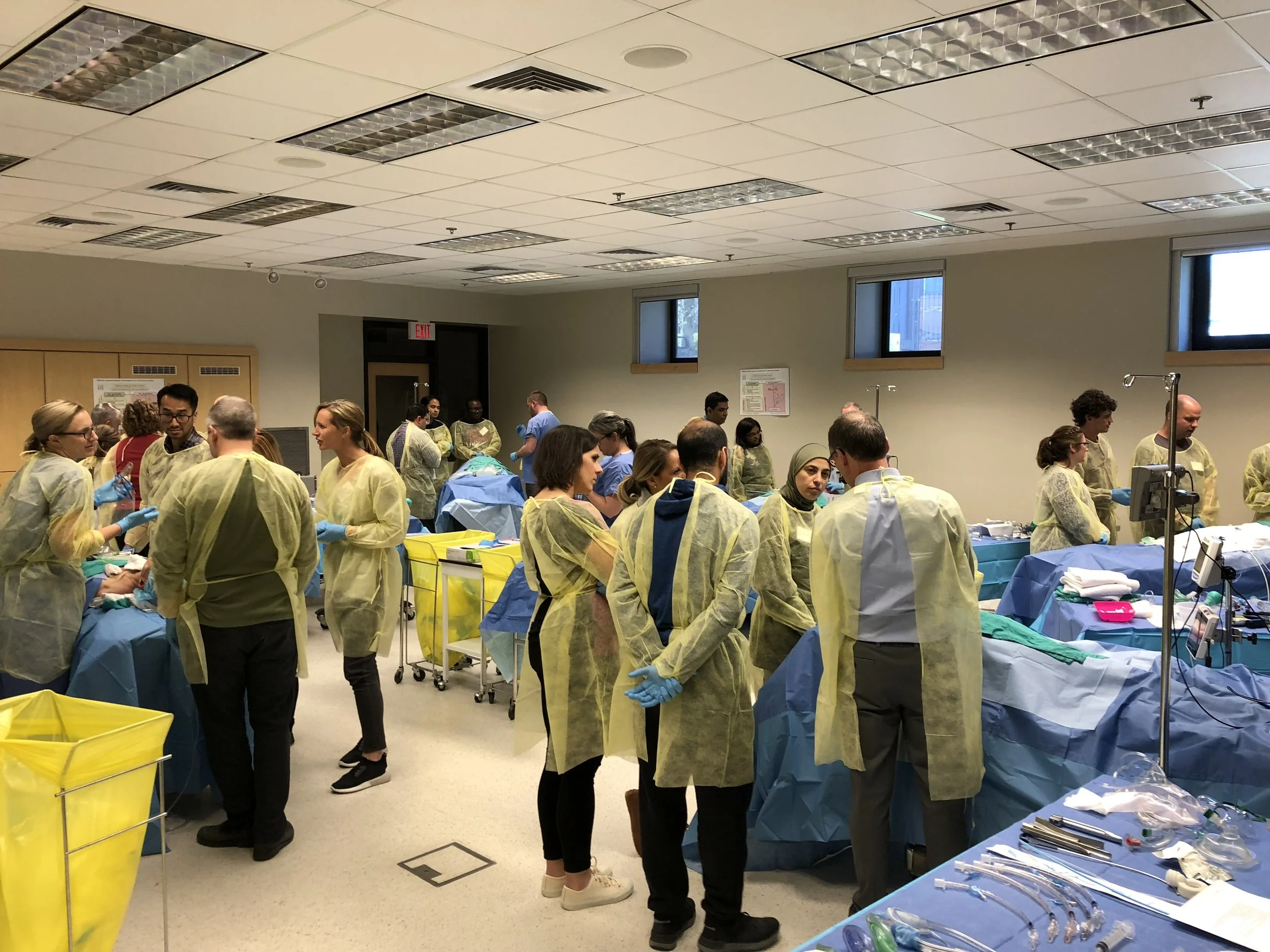
A procedure focused program offering unique repetitive practice opportunities that reinforce core and advanced airway skills using a variety of currently available and increasingly accessible airway devices. Attendees will learn not only from experienced airway educators that understand the varied practice environments clinician’s face but also from the greatest teachers of all, specially prepared clinical cadavers producing unparalleled high fidelity skills learning opportunities.
-
This program uses specially prepared Clinical Cadavers
5:1 learner-to-instructor with pragmatic, experienced clinical educators from emergency medicine & anesthesiology.
Visualize the lung respond to ventilation strategies in real time, requiring learners to adjust technique based on dynamic anatomical feedback.
Visualize dynamic and variable anatomy to reinforce optimized tracheal intubation by video laryngoscopy (VL) with a variety of commonly available Macintosh and Hyperangulated VL blades.
Learn advanced skills such as managing the contaminated airway (SALAD), use a flexible endoscope for advanced airway assessment (nasal endoscopy and confirming tracheal tube location.
Practice and perform airway rescue techniques using a supraglottic airway and performing a bougie assisted cricothyrotomy.
-
Formulate a plan for safely securing a patient’s airway, based on an appraisal and application of current published literature.
Maintain patient oxygenation throughout the airway management sequence, using effective pre-oxygenation, face mask ventilation and apneic oxygenation techniques.
Recognize upper airway anatomic landmarks during video laryngoscopy and interact with the exposed anatomy to maximize successful tracheal intubation.
Recognize when difficulty is occurring with airway management and respond with a structured approach, to include supraglottic airway placement and/or use of a combination of more than one device to facilitate tracheal intubation.
Distinguish between an unsuccessful and a successful attempt at patient ventilation (e.g., esophageal intubation).
Recognize a “cannot ventilate, cannot oxygenate” situation and perform an emergency cricothyrotomy.
Advocate for the equipment and medications required to facilitate standard-of-care airway management in their home workplace.
-
0730-0800 Arrival/registration/breakfast
0800-0820 Introduction and review of agenda and program logistics
0820-0845 Patient Preparation and Peri-intubation Oxygenation/Ventilation Strategies
0845-0930 Workshop 1: Peri-intubation Oxygenation/Ventilation Strategies0930-0940 Macintosh Video Laryngoscopy (VL)
0940-0955 Coffee break
0955-1115 Workshop 2: Mac Video laryngoscopy/rapid cycle practice
1115-1135 Hyperangulated Video Laryngoscopy1135-1230 Workshop 3: Hyperangulated Video laryngoscopy/rapid cycle practice
1230-1310 Lunch
1310-1340 Airway management success and approach to anticipated & unanticipated difficult airways1340-1540 Workshop 4: Advanced Procedures: Management of the Soiled Airway,
Nasopharyngoscopy, Tracheal tube confirmation.
1540-1610 Working coffee break and fireside case discussions
1610-1710 Workshop 5: Preparing and performing bougie assisted cricothyrotomy
1710-1730 Wrap up*Timings (other than start and finish time) and materials subject to change
-
CFPC: This 1 credit per hour Assessment Program has been certified by the College of Family Physicians of Canada for up to 8 Mainpro+ credits
RCPSC: This activity is an Accredited Simulation Activity (Section 3) as defined by the Maintenance of Certification Program of the Royal College of Physicians and Surgeons of Canada, and approved by CAEP. You may claim a maximum of 8 hours (credits are automatically calculated).
This program was developed by AIME Training (ATI) with support from the Canadian Association of Emergency Physicians (CAEP) and was planned to achieve scientific integrity, objectivity and balance.
-
CAEP Members: $1650 (CAD)
Non-members: $1975 (CAD)
Residents: $1450 (CAD)
-
Instructors for AIME are experienced educators and clinicians from across the country.