
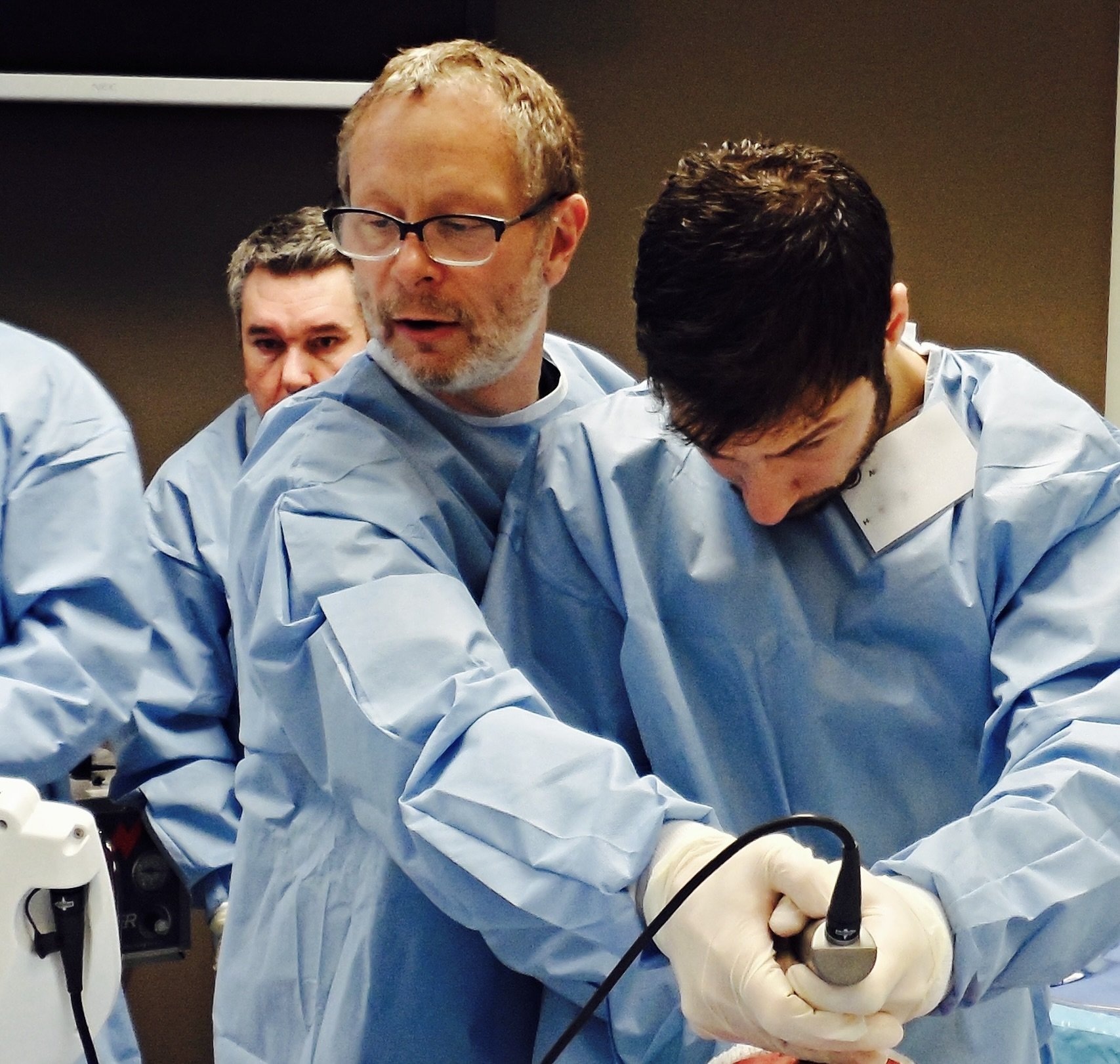
Upcoming Programs
AIME course offer practical, evidence-informed training designed to give clinicians the confidence and skills to manage emergency airways. Through a highly interactive format, participants learn strategies they can apply on their very next shift — emphasizing real-world decision-making, human factors, and the safe use of essential techniques. Each course is led by experienced faculty who bring decades of frontline expertise, ensuring that learners leave better prepared for the challenges of airway management in emergency care.
View our upcoming course dates or join the waitlist below.
AIME Clinical Cadaver | Halifax
Visit the CAEP site for more info on upcoming AIME courses.
A Hands-on, Advanced Airway Learning Experience Using Clinical Cadavers
A procedure focused program offering unique repetitive practice opportunities that reinforce core and advanced airway skills using a variety of currently available and increasingly accessible airway devices. Attendees will learn not only from experienced airway educators that understand the varied practice environments clinician’s face but also from the greatest teachers of all, specially prepared clinical cadavers producing unparalleled high fidelity skills learning opportunities.
Course Highlights
This program uses specially prepared Clinical Cadavers
5:1 learner-to-instructor with pragmatic, experienced clinical educators from emergency medicine anesthesiology.
Visualize the lung respond to ventilation strategies in real time, requiring learners to adjust technique based on dynamic anatomical feedback.
Visualize dynamic and variable anatomy to reinforce optimized tracheal intubation by video laryngoscopy (VL) with a variety of commonly available Macintosh and Hyperangulated VL blades.
Learn advanced skills such as managing the contaminated airway (SALAD), use a flexible endoscope for advanced airway assessment (nasal endoscopy and confirming tracheal tube location.
Practice and perform airway rescue techniques using a supraglottic airway and performing a bougie assisted cricothyrotomy.
Objectives
Formulate a plan for safely securing a patient’s airway, based on an appraisal and application of current published literature.
Maintain patient oxygenation throughout the airway management sequence, using effective pre-oxygenation, face mask ventilation and apneic oxygenation techniques.
Recognize upper airway anatomic landmarks during video laryngoscopy and interact with the exposed anatomy to maximize successful tracheal intubation.
Recognize when difficulty is occurring with airway management and respond with a structured approach, to include supraglottic airway placement and/or use of a combination of more than one device to facilitate tracheal intubation.
Distinguish between an unsuccessful and a successful attempt at patient ventilation (e.g., esophageal intubation).
Recognize a “cannot ventilate, cannot oxygenate” situation and perform an emergency cricothyrotomy.
Advocate for the equipment and medications required to facilitate standard-of-care airway management in their home workplace.
Program Day
0730-0800 Arrival/registration/breakfast
0800-0820 Introduction and review of agenda and program logistics
0820-0845 Patient Preparation and Peri-intubation Oxygenation/Ventilation Strategies
0845-0930 Workshop 1: Peri-intubation Oxygenation/Ventilation Strategies
0930-0940 Macintosh Video Laryngoscopy (VL)
0940-0955 Coffee break
0955-1115 Workshop 2: Mac Video laryngoscopy/rapid cycle practice
1115-1135 Hyperangulated Video Laryngoscopy
1135-1230 Workshop 3: Hyperangulated Video laryngoscopy/rapid cycle practice
1230-1310 Lunch
1310-1340 Airway management success and approach to anticipated & unanticipated difficult airways.
1340-1540 Workshop 4: Advanced Procedures: Management of the Soiled Airway,
Nasopharyngoscopy, Tracheal tube confirmation.
1540-1610 Working coffee break and fireside case discussions
1610-1710 Workshop 5: Preparing and performing bougie assisted cricothyrotomy
1710-1730 Wrap up
*Timings (other than start end finish time) and materials subject to change
CPD Credits
CFPC: This 1 credit per hour Assessment Program has been certified by the College of Family Physicians of Canada for up to 8 Mainpro+ credits
RCPSC: This activity is an Accredited Simulation Activity (Section 3) as defined by the Maintenance of Certification Program of the Royal College of Physicians and Surgeons of Canada, and approved by CAEP. You may claim a maximum of 8 hours (credits are automatically calculated).
This program was developed by AIME Training (ATI) with support from the Canadian Association of Emergency Physicians (CAEP) and was planned to achieve scientific integrity, objectivity and balance.
Program Fees
CAEP Members: $1650 (CAD)
Non-members: $1975 (CAD)
Residents: $1450 (CAD)
Military Members: $1650 (CAD)
Instructors
Adam Law
George Kovacs
Nick Sowers
Adam Parks
Alex Poulton
Kathryn Sparrow
Instructors for AIME are experienced educators and clinicians from across the country.
AIME On-the-Road | Toronto
@ Family Medicine Forum (FMF conference registration NOT required)
Visit the CAEP site for more info on upcoming AIME courses.
For over 25 years AIME On-the-Road has been providing high value educational support for clinicians in Canada and other regions around the world who are responsible for airway management in emergencies. Management of both the anticipated and unanticIpated difficult airway requires evidence-based decision making and skillful procedural execution customized the patient’s presentation and the providers clinical environment. This program uses case-based group discussion with hands-on workshops using commonly available/increasingly accessible airway devices with the goal of enhancing provider confidence and skills that ultimately improve patient outcomes.
Course Highlights
Case-based decision-making
Patient optimization before airway management
Hyperangulated and Macintosh video laryngoscopy
Awake and rapid sequence intubation approaches
Difficult airway management and rescue ventilation/oxygenation
Cricothyrotomy decision-making and execution
Canadian Airway Focused Group guideline algorithms
Pre-program education materials with customized videos
Small-group learning with 5–6:1 instructor ratios
Objectives
Practice making acute care airway management decisions.
Organize a practical staged approach to airway management.
Choose the most appropriate method of airway management based on a variety of patient presentations.
Choose appropriate pharmacologic agents used to facilitate airway management.
Illustrate when and how to use various tools and adjuncts for managing the difficult airway.
Program Day
Introduction and Oxygenation (0730 breakfast, 0800 start)
Workshop 1: Peri-intubation Oxygenation good lungs bad lungs, BVM & SGA Pearls
Review and Mac Videolaryngoscopy
COFFEE
Workshop 2: Mac Videolaryngoscopy (VL)
Mac VL Review and Hyperangulated Video Laryngoscopy
Workshop 3: Hyperangulated (HA) VL
HA VL review and intubation approach
LUNCH (on site)
Approach to the Difficult Airway
Workshop 4: Nasal endoscopy/Cricothyrotomy/Awake intubation/SALAD (contaminated airway)
Workshop 5: Case Discussions, Drugs and stuff working Coffee
Workshop 6: Simulation and skill consolidation and practice
Wrap-up / Evaluation (1730-1745)
*Timings (other than start end finish time) and materials subject to change
CPD Credits
CFPC
This 2 credit per hour Assessment program has been certified by the College of Family Physicians of Canada for up to 22 certified Mainpro+ credits
RCPSC
This event is an Accredited Group Learning Activity (Section 1) as defined by the Maintenance of Certification Program of the Royal College of Physicians and Surgeons of Canada, and approved by CAEP. You may claim a maximum of 11 hours (credits are automatically calculated).
This program was developed by AIME Training (ATI) with support from the Canadian Association of Emergency Physicians (CAEP) and was planned to achieve scientific integrity, objectivity and balance.
Program Fees
CAEP Members: $1650 (CAD)
Non-members: $1975 (CAD)
Residents: $1450 (CAD)
Military Members: $1650 (CAD)
Instructors
Kelly Eggink
Heather Flemming
Samantha Jang-Stewart
Neil Long
Instructors for AIME are experienced educators and clinicians from across the country.
AIME On-the-Road | Toronto
@ Family Medicine Forum (FMF conference registration NOT required)
Visit the CAEP site for more info on upcoming AIME courses.
For over 25 years AIME On-the-Road has been providing high value educational support for clinicians in Canada and other regions around the world who are responsible for airway management in emergencies. Management of both the anticipated and unanticIpated difficult airway requires evidence-based decision making and skillful procedural execution customized the patient’s presentation and the providers clinical environment. This program uses case-based group discussion with hands-on workshops using commonly available/increasingly accessible airway devices with the goal of enhancing provider confidence and skills that ultimately improve patient outcomes.
Course Highlights
Case-based decision-making
Patient optimization before airway management
Hyperangulated and Macintosh video laryngoscopy
Awake and rapid sequence intubation approaches
Difficult airway management and rescue ventilation/oxygenation
Cricothyrotomy decision-making and execution
Canadian Airway Focused Group guideline algorithms
Pre-program education materials with customized videos
Small-group learning with 5–6:1 instructor ratios
Objectives
Practice making acute care airway management decisions.
Organize a practical staged approach to airway management.
Choose the most appropriate method of airway management based on a variety of patient presentations.
Choose appropriate pharmacologic agents used to facilitate airway management.
Illustrate when and how to use various tools and adjuncts for managing the difficult airway.
Program Day
Introduction and Oxygenation (0730 breakfast, 0800 start)
Workshop 1: Peri-intubation Oxygenation good lungs bad lungs, BVM & SGA Pearls
Review and Mac Videolaryngoscopy
COFFEE
Workshop 2: Mac Videolaryngoscopy (VL)
Mac VL Review and Hyperangulated Video Laryngoscopy
Workshop 3: Hyperangulated (HA) VL
HA VL review and intubation approach
LUNCH (on site)
Approach to the Difficult Airway
Workshop 4: Nasal endoscopy/Cricothyrotomy/Awake intubation/SALAD (contaminated airway)
Workshop 5: Case Discussions, Drugs and stuff working Coffee
Workshop 6: Simulation and skill consolidation and practice
Wrap-up / Evaluation (1730-1745)
*Timings (other than start end finish time) and materials subject to change
CPD Credits
CFPC
This 2 credit per hour Assessment program has been certified by the College of Family Physicians of Canada for up to 22 certified Mainpro+ credits
RCPSC
This event is an Accredited Group Learning Activity (Section 1) as defined by the Maintenance of Certification Program of the Royal College of Physicians and Surgeons of Canada, and approved by CAEP. You may claim a maximum of 11 hours (credits are automatically calculated).
This program was developed by AIME Training (ATI) with support from the Canadian Association of Emergency Physicians (CAEP) and was planned to achieve scientific integrity, objectivity and balance.
Program Fees
CAEP Members: $1650 (CAD)
Non-members: $1975 (CAD)
Residents: $1450 (CAD)
Military Members: $1650 (CAD)
Instructors for AIME are experienced educators and clinicians from across the country.
AIME Clinical Cadaver | Halifax
Visit the CAEP site for more info on upcoming AIME courses.
A Hands-on, Advanced Airway Learning Experience Using Clinical Cadavers
A procedure-focused program offering unique repetitive practice opportunities that reinforce core and advanced airway skills using a variety of currently available and increasingly accessible airway devices. Attendees will learn not only from experienced airway educators that understand the varied practice environments clinician’s face but also from the greatest teachers of all, specially prepared clinical cadavers producing unparalleled high fidelity skills learning opportunities.
Course Highlights
This program uses specially prepared Clinical Cadavers
5:1 learner-to-instructor with pragmatic, experienced clinical educators from emergency medicine anesthesiology.
Visualize the lung respond to ventilation strategies in real time, requiring learners to adjust technique based on dynamic anatomical feedback.
Visualize dynamic and variable anatomy to reinforce optimized tracheal intubation by video laryngoscopy (VL) with a variety of commonly available Macintosh and Hyperangulated VL blades.
Learn advanced skills such as managing the contaminated airway (SALAD), use a flexible endoscope for advanced airway assessment (nasal endoscopy and confirming tracheal tube location.
Practice and perform airway rescue techniques using a supraglottic airway and performing a bougie assisted cricothyrotomy.
Objectives
Formulate a plan for safely securing a patient’s airway, based on an appraisal and application of current published literature.
Maintain patient oxygenation throughout the airway management sequence, using effective pre-oxygenation, face mask ventilation and apneic oxygenation techniques.
Recognize upper airway anatomic landmarks during video laryngoscopy and interact with the exposed anatomy to maximize successful tracheal intubation.
Recognize when difficulty is occurring with airway management and respond with a structured approach, to include supraglottic airway placement and/or use of a combination of more than one device to facilitate tracheal intubation.
Distinguish between an unsuccessful and a successful attempt at patient ventilation (e.g., esophageal intubation).
Recognize a “cannot ventilate, cannot oxygenate” situation and perform an emergency cricothyrotomy.
Advocate for the equipment and medications required to facilitate standard-of-care airway management in their home workplace.
Program Day
0730-0800 Arrival/registration/breakfast
0800-0820 Introduction and review of agenda and program logistics
0820-0845 Patient Preparation and Peri-intubation Oxygenation/Ventilation Strategies
0845-0930 Workshop 1: Peri-intubation Oxygenation/Ventilation Strategies
0930-0945 Macintosh Video Laryngoscopy (VL)
0945-1000 Coffee break
1000-1040 Workshop 2: Mac Video laryngoscopy/rapid cycle practice
1040-1115 Hyperangulated Video Laryngoscopy
1115-1230 Workshop 3: Hyperangulated Video laryngoscopy/rapid cycle practice
1230-1310 Lunch
1310-1340 Airway management success and approach to anticipated & unanticipated difficult airways.
1340-1500 Workshop 4: Advanced Procedures: Management of the Soiled Airway,
Nasopharyngoscopy, Tracheal tube confirmation.
1540-1615 Working coffee break and fireside case discussions
1615-1645 Workshop 5: Preparing and performing bougie assisted cricothyrotomy
1645-1700 Wrap up
*Timings (other than start end finish time) and materials subject to change
CPD Credits
CFPC: This 1 credit per hour Assessment Program has been certified by the College of Family Physicians of Canada for up to 8 Mainpro+ credits
RCPSC: This activity is an Accredited Simulation Activity (Section 3) as defined by the Maintenance of Certification Program of the Royal College of Physicians and Surgeons of Canada, and approved by CAEP. You may claim a maximum of 8 hours (credits are automatically calculated).
This program was developed by AIME Training (ATI) with support from the Canadian Association of Emergency Physicians (CAEP) and was planned to achieve scientific integrity, objectivity and balance.
Program Fees
CAEP Members: $1650 (CAD)
Non-members: $1975 (CAD)
Residents: $1450 (CAD)
Military Members: $1650 (CAD)
Instructors
Adam Law
George Kovacs
Nick Sowers
Adam Parks
Alex Poulton
Kathryn Sparrow
Instructors for AIME are experienced educators and clinicians from across the country.
AIME On-the-Road | Diamond Valley
Visit the CAEP site for more info on upcoming AIME courses.
For over 25 years AIME On-the-Road has been providing high value educational support for clinicians in Canada and other regions around the world who are responsible for airway management in emergencies. Management of both the anticipated and unanticipated difficult airway requires evidence-based decision making and skillful procedural execution customized the patient’s presentation and the providers clinical environment. This program uses case-based group discussion with hands-on workshops using commonly available/increasingly accessible airway devices with the goal of enhancing provider confidence and skills that ultimately improve patient outcomes.
Course Highlights
Case-based decision-making
Patient optimization before airway management
Hyperangulated and Macintosh video laryngoscopy
Awake and rapid sequence intubation approaches
Difficult airway management and rescue ventilation/oxygenation
Cricothyrotomy decision-making and execution
Canadian Airway Focused Group guideline algorithms
Pre-program education materials with customized videos
Small-group learning with 5–6:1 instructor ratios
Objectives
Practice making acute care airway management decisions.
Organize a practical staged approach to airway management.
Choose the most appropriate method of airway management based on a variety of patient presentations.
Choose appropriate pharmacologic agents used to facilitate airway management.
Illustrate when and how to use various tools and adjuncts for managing the difficult airway.
Program Day
Introduction and Oxygenation (0730 breakfast, 0800 start)
Workshop 1: Peri-intubation Oxygenation good lungs bad lungs, BVM & SGA Pearls
Review and Mac Videolaryngoscopy
COFFEE
Workshop 2: Mac Videolaryngoscopy (VL)
Mac VL Review and Hyperangulated Video Laryngoscopy
Workshop 3: Hyperangulated (HA) VL
HA VL review and intubation approach
LUNCH (on site)
Approach to the Difficult Airway
Workshop 4: Nasal endoscopy/Cricothyrotomy/Awake intubation/SALAD (contaminated airway)
Workshop 5: Case Discussions, Drugs and stuff working Coffee
Workshop 6: Simulation and skill consolidation and practice
Wrap-up / Evaluation (1730-1745)
*Timings (other than start end finish time) and materials subject to change
CPD Credits
CFPC
This 2 credit per hour Assessment program has been certified by the College of Family Physicians of Canada for up to 22 certified Mainpro+ credits
RCPSC
This event is an Accredited Group Learning Activity (Section 1) as defined by the Maintenance of Certification Program of the Royal College of Physicians and Surgeons of Canada, and approved by CAEP. You may claim a maximum of 11 hours (credits are automatically calculated).
This program was developed by AIME Training (ATI) with support from the Canadian Association of Emergency Physicians (CAEP) and was planned to achieve scientific integrity, objectivity and balance.
Program Fees
CAEP Members: $1650 (CAD)
Non-members: $1975 (CAD)
Residents: $1450 (CAD)
Military Members: $1650 (CAD)
Instructors for AIME are experienced educators and clinicians from across the country.
AIME On-the-Road | Diamond Valley
Visit the CAEP site for more info on upcoming AIME courses.
For over 25 years AIME On-the-Road has been providing high value educational support for clinicians in Canada and other regions around the world who are responsible for airway management in emergencies. Management of both the anticipated and unanticipated difficult airway requires evidence-based decision making and skillful procedural execution customized the patient’s presentation and the providers clinical environment. This program uses case-based group discussion with hands-on workshops using commonly available/increasingly accessible airway devices with the goal of enhancing provider confidence and skills that ultimately improve patient outcomes.
Course Highlights
Case-based decision-making
Patient optimization before airway management
Hyperangulated and Macintosh video laryngoscopy
Awake and rapid sequence intubation approaches
Difficult airway management and rescue ventilation/oxygenation
Cricothyrotomy decision-making and execution
Canadian Airway Focused Group guideline algorithms
Pre-program education materials with customized videos
Small-group learning with 5–6:1 instructor ratios
Objectives
Practice making acute care airway management decisions.
Organize a practical staged approach to airway management.
Choose the most appropriate method of airway management based on a variety of patient presentations.
Choose appropriate pharmacologic agents used to facilitate airway management.
Illustrate when and how to use various tools and adjuncts for managing the difficult airway.
Program Day
Introduction and Oxygenation (0730 breakfast, 0800 start)
Workshop 1: Peri-intubation Oxygenation good lungs bad lungs, BVM & SGA Pearls
Review and Mac Videolaryngoscopy
COFFEE
Workshop 2: Mac Videolaryngoscopy (VL)
Mac VL Review and Hyperangulated Video Laryngoscopy
Workshop 3: Hyperangulated (HA) VL
HA VL review and intubation approach
LUNCH (on site)
Approach to the Difficult Airway
Workshop 4: Nasal endoscopy/Cricothyrotomy/Awake intubation/SALAD (contaminated airway)
Workshop 5: Case Discussions, Drugs and stuff working Coffee
Workshop 6: Simulation and skill consolidation and practice
Wrap-up / Evaluation (1730-1745)
*Timings (other than start end finish time) and materials subject to change
CPD Credits
CFPC
This 2 credit per hour Assessment program has been certified by the College of Family Physicians of Canada for up to 22 certified Mainpro+ credits
RCPSC
This event is an Accredited Group Learning Activity (Section 1) as defined by the Maintenance of Certification Program of the Royal College of Physicians and Surgeons of Canada, and approved by CAEP. You may claim a maximum of 11 hours (credits are automatically calculated).
This program was developed by AIME Training (ATI) with support from the Canadian Association of Emergency Physicians (CAEP) and was planned to achieve scientific integrity, objectivity and balance.
Program Fees
CAEP Members: $1650 (CAD)
Non-members: $1975 (CAD)
Residents: $1450 (CAD)
Military Members: $1650 (CAD)
Instructors for AIME are experienced educators and clinicians from across the country.
AIME Awake | Halifax
Visit the CAEP site for more info on upcoming courses.
Making awake tracheal intubation a real option for managing the anticipated difficult airway in patient’s requiring emergency airway management
Guidelines for airway management in patients with an anticipated difficult airway universally include the option of performing an ‘awake’ tracheal intubation (ATI). Performing a rapid sequence intubation (RSI) using video laryngoscopy has become a standard approach to facilitate tracheal intubation for airway management in emergencies, whereas experience in performing ATI is limited. Awake tracheal intubation however remains a necessary alternative to RSI in not only anticipated anatomically difficult airway cases, but also for selected physiologically compromised apnea intolerant patients. This program provides attendees with with an approach and the skills necessary to safely perform ATI when indicated. Instructors from Emergency Medicine and Anesthesiology along with specially prepared clinical cadavers provide an unparalleled unique high fidelity skills learning experience.
Course Highlights
This program uses specially prepared Clinical Cadavers
5:1 learner-to-instructor with pragmatic, experienced clinical educators from emergency medicine anesthesiology.
Review decision-making/ indications for awake tracheal intubation (ATI) for management of anatomically and physiologically difficult airway cases.
Practice topicalization techniques for ATI
Repetitive practice in oral and nasal flexible endoscopic intubation
Video laryngoscopy–assisted ATI training.
Learn-do-repeat rapid cycle deliberate practice to consolidate learning and maximize exposures.
Group discussions opportunities to review cases and address challenges clinician’s may encounter in their unique work environment.
Objectives
Based on airway evaluation, indicate when ATI is the safest option for securing the airway.
Identify the components of awake tracheal intubation (ATI).
Communicate with the team and patient in preparation for and during ATI.
Perform effective topical airway anesthesia to facilitate well-tolerated ATI.
Use flexible endoscopy and video laryngoscopy to facilitate tracheal intubation in clinical cadavers.
Recognize when to enhance the standard airway evaluation with awake internal airway assessment and use flexible endoscopy or video laryngoscopy for the purpose.
Identify and manage difficulties that may arise during ATI.
Program Day
0800-0830 Arrival/registration/breakfast
0830-0850 Introduction and review of agenda and program logistics
0850-0930 Didactic: Introduction to awake tracheal intubation (ATI)
0930-1000 Hands-on 1: Topical airway anesthesia for ATI
1000-1020 Coffee break.
1020-1200 Hands-on 2: Oral ATI using flexible endoscopy
1200-1240 Lunch
1240-1320 Hands-on 3: Oral ATI using video laryngoscopy
1320-1400 Hands-on 4: Nasal ATI using flexible endoscopy
1400-1500 Case simulations and discussion (with refreshments)
1500-1600 Hands-on 5: Scenario based consolidation simulation
1600-1630 Cognitive consolidation and wrap-up
*Timings (other than start end finish time) and materials subject to change
CPD Credits
CFPC: This activity has been certified by the College of Family Physicians of Canada and Nova Scotia Chapter for up to 6.75 Mainpro+ credits.
RCPSC: This activity is an Accredited Simulation Activity (Section 3) as defined by the Maintenance of Certification Program of the Royal College of Physicians and Surgeons of Canada, and approved by CAEP. You may claim a maximum of 6.75 hours (credits are automatically calculated).
This program was developed by AIME Training (ATI) with support from the Canadian Association of Emergency Physicians (CAEP) and was planned to achieve scientific integrity, objectivity and balance.
Program Fees
CAEP Members: $1650 (CAD)
Non-members: $1975 (CAD)
Residents: $1450 (CAD)
Instructors
Instructors for AIME are experienced educators and clinicians from across the country.
AIME On-the-Road | Campbell River
Visit the CAEP site for more info on upcoming AIME courses.
For over 25 years AIME On-the-Road has been providing high value educational support for clinicians in Canada and other regions around the world who are responsible for airway management in emergencies. Management of both the anticipated and unanticpated difficult airway requires evidence-based decision making and skillful procedural execution customized the patient’s presentation and the providers clinical environment. This program uses case-based group discussion with hands-on workshops using commonly available/increasingly accessible airway devices with the goal of enhancing provider confidence and skills that ultimately improve patient outcomes.
Course Highlights
Case-based decision-making
Patient optimization before airway management
Hyperangulated and Macintosh video laryngoscopy
Awake and rapid sequence intubation approaches
Difficult airway management and rescue ventilation/oxygenation
Cricothyrotomy decision-making and execution
Canadian Airway Focused Group guideline algorithms
Pre-program education materials with customized videos
Small-group learning with 5–6:1 instructor ratios
Objectives
Practice making acute care airway management decisions.
Organize a practical staged approach to airway management.
Choose the most appropriate method of airway management based on a variety of patient presentations.
Choose appropriate pharmacologic agents used to facilitate airway management.
Illustrate when and how to use various tools and adjuncts for managing the difficult airway.
Program Day
Introduction and Oxygenation (0730 breakfast, 0800 start)
Workshop 1: Peri-intubation Oxygenation good lungs bad lungs, BVM & SGA Pearls
Review and Mac Videolaryngoscopy
COFFEE
Workshop 2: Mac Videolaryngoscopy (VL)
Mac VL Review and Hyperangulated Video Laryngoscopy
Workshop 3: Hyperangulated (HA) VL
HA VL review and intubation approach
LUNCH (on site)
Approach to the Difficult Airway
Workshop 4: Nasal endoscopy/Cricothyrotomy/Awake intubation/SALAD (contaminated airway)
Workshop 5: Case Discussions, Drugs and stuff working Coffee
Workshop 6: Simulation and skill consolidation and practice
Wrap-up / Evaluation (1730-1745)
*Timings (other than start end finish time) and materials subject to change
CPD Credits
CFPC
This 2 credit per hour Assessment program has been certified by the College of Family Physicians of Canada for up to 22 certified Mainpro+ credits
RCPSC
This event is an Accredited Group Learning Activity (Section 1) as defined by the Maintenance of Certification Program of the Royal College of Physicians and Surgeons of Canada, and approved by CAEP. You may claim a maximum of 11 hours (credits are automatically calculated).
This program was developed by AIME Training (ATI) with support from the Canadian Association of Emergency Physicians (CAEP) and was planned to achieve scientific integrity, objectivity and balance.
Program Fees
CAEP Members: $1650 (CAD)
Non-members: $1975 (CAD)
Residents: $1450 (CAD)
Military Members: $1650 (CAD)
Instructors
Kelly Eggink
Heather Flemming
Samantha Jang-Stewart
Neil Long
Instructors for AIME are experienced educators and clinicians from across the country.
AIME On-the-Road | Campbell River
Visit the CAEP site for more info on upcoming AIME courses.
For over 25 years AIME On-the-Road has been providing high value educational support for clinicians in Canada and other regions around the world who are responsible for airway management in emergencies. Management of both the anticipated and unanticpated difficult airway requires evidence-based decision making and skillful procedural execution customized the patient’s presentation and the providers clinical environment. This program uses case-based group discussion with hands-on workshops using commonly available/increasingly accessible airway devices with the goal of enhancing provider confidence and skills that ultimately improve patient outcomes.
Course Highlights
Case-based decision-making
Patient optimization before airway management
Hyperangulated and Macintosh video laryngoscopy
Awake and rapid sequence intubation approaches
Difficult airway management and rescue ventilation/oxygenation
Cricothyrotomy decision-making and execution
Canadian Airway Focused Group guideline algorithms
Pre-program education materials with customized videos
Small-group learning with 5–6:1 instructor ratios
Objectives
Practice making acute care airway management decisions.
Organize a practical staged approach to airway management.
Choose the most appropriate method of airway management based on a variety of patient presentations.
Choose appropriate pharmacologic agents used to facilitate airway management.
Illustrate when and how to use various tools and adjuncts for managing the difficult airway.
Program Day
Introduction and Oxygenation (0730 breakfast, 0800 start)
Workshop 1: Peri-intubation Oxygenation good lungs bad lungs, BVM & SGA Pearls
Review and Mac Videolaryngoscopy
COFFEE
Workshop 2: Mac Videolaryngoscopy (VL)
Mac VL Review and Hyperangulated Video Laryngoscopy
Workshop 3: Hyperangulated (HA) VL
HA VL review and intubation approach
LUNCH (on site)
Approach to the Difficult Airway
Workshop 4: Nasal endoscopy/Cricothyrotomy/Awake intubation/SALAD (contaminated airway)
Workshop 5: Case Discussions, Drugs and stuff working Coffee
Workshop 6: Simulation and skill consolidation and practice
Wrap-up / Evaluation (1730-1745)
*Timings (other than start end finish time) and materials subject to change
CPD Credits
CFPC
This 2 credit per hour Assessment program has been certified by the College of Family Physicians of Canada for up to 22 certified Mainpro+ credits
RCPSC
This event is an Accredited Group Learning Activity (Section 1) as defined by the Maintenance of Certification Program of the Royal College of Physicians and Surgeons of Canada, and approved by CAEP. You may claim a maximum of 11 hours (credits are automatically calculated).
This program was developed by AIME Training (ATI) with support from the Canadian Association of Emergency Physicians (CAEP) and was planned to achieve scientific integrity, objectivity and balance.
Program Fees
CAEP Members: $1650 (CAD)
Non-members: $1975 (CAD)
Residents: $1450 (CAD)
Military Members: $1650 (CAD)
Instructors
Kelly Eggink
Heather Flemming
Samantha Jang-Stewart
Neil Long
Instructors for AIME are experienced educators and clinicians from across the country.
AIME On-the-Road | Whistler
Pre-con to St. Paul’s EM Update
Visit the CAEP site for more info on upcoming AIME courses.
For over 25 years AIME On-the-Road has been providing high value educational support for clinicians in Canada and other regions around the world who are responsible for airway management in emergencies. Management of both the anticipated and unanticpated difficult airway requires evidence-based decision making and skillful procedural execution customized the patient’s presentation and the providers clinical environment. This program uses case-based group discussion with hands-on workshops using commonly available/increasingly accessible airway devices with the goal of enhancing provider confidence and skills that ultimately improve patient outcomes.
Course Highlights
Case-based decision-making
Patient optimization before airway management
Hyperangulated and Macintosh video laryngoscopy
Awake and rapid sequence intubation approaches
Difficult airway management and rescue ventilation/oxygenation
Cricothyrotomy decision-making and execution
Canadian Airway Focused Group guideline algorithms
Pre-program education materials with customized videos
Small-group learning with 5–6:1 instructor ratios
Objectives
Practice making acute care airway management decisions.
Organize a practical staged approach to airway management.
Choose the most appropriate method of airway management based on a variety of patient presentations.
Choose appropriate pharmacologic agents used to facilitate airway management.
Illustrate when and how to use various tools and adjuncts for managing the difficult airway.
Program Day
Introduction and Oxygenation (0730 breakfast, 0800 start)
Workshop 1: Peri-intubation Oxygenation good lungs bad lungs, BVM & SGA Pearls
Review and Mac Videolaryngoscopy
COFFEE
Workshop 2: Mac Videolaryngoscopy (VL)
Mac VL Review and Hyperangulated Video Laryngoscopy
Workshop 3: Hyperangulated (HA) VL
HA VL review and intubation approach
LUNCH (on site)
Approach to the Difficult Airway
Workshop 4: Nasal endoscopy/Cricothyrotomy/Awake intubation/SALAD (contaminated airway)
Workshop 5: Case Discussions, Drugs and stuff working Coffee
Workshop 6: Simulation and skill consolidation and practice
Wrap-up / Evaluation (1730-1745)
*Timings (other than start end finish time) and materials subject to change
CPD Credits
CFPC
This 2 credit per hour Assessment program has been certified by the College of Family Physicians of Canada for up to 22 certified Mainpro+ credits
RCPSC
This event is an Accredited Group Learning Activity (Section 1) as defined by the Maintenance of Certification Program of the Royal College of Physicians and Surgeons of Canada, and approved by CAEP. You may claim a maximum of 11 hours (credits are automatically calculated).
This program was developed by AIME Training (ATI) with support from the Canadian Association of Emergency Physicians (CAEP) and was planned to achieve scientific integrity, objectivity and balance.
Program Fees
CAEP Members: $1650 (CAD)
Non-members: $1975 (CAD)
Residents: $1450 (CAD)
Military Members: $1650 (CAD)
Instructors
Heather Flemming
Andrew MacPherson
Peter Rose
Jan Trojanowski
Instructors for AIME are experienced educators and clinicians from across the country.
AIME On-the-Road | Whistler
Pre-con to St. Paul’s EM Update
Visit the CAEP site for more info on upcoming AIME courses.
For over 25 years AIME On-the-Road has been providing high value educational support for clinicians in Canada and other regions around the world who are responsible for airway management in emergencies. Management of both the anticipated and unanticpated difficult airway requires evidence-based decision making and skillful procedural execution customized the patient’s presentation and the providers clinical environment. This program uses case-based group discussion with hands-on workshops using commonly available/increasingly accessible airway devices with the goal of enhancing provider confidence and skills that ultimately improve patient outcomes.
Course Highlights
Case-based decision-making
Patient optimization before airway management
Hyperangulated and Macintosh video laryngoscopy
Awake and rapid sequence intubation approaches
Difficult airway management and rescue ventilation/oxygenation
Cricothyrotomy decision-making and execution
Canadian Airway Focused Group guideline algorithms
Pre-program education materials with customized videos
Small-group learning with 5–6:1 instructor ratios
Objectives
Practice making acute care airway management decisions.
Organize a practical staged approach to airway management.
Choose the most appropriate method of airway management based on a variety of patient presentations.
Choose appropriate pharmacologic agents used to facilitate airway management.
Illustrate when and how to use various tools and adjuncts for managing the difficult airway.
Program Day
Introduction and Oxygenation (0730 breakfast, 0800 start)
Workshop 1: Peri-intubation Oxygenation good lungs bad lungs, BVM & SGA Pearls
Review and Mac Videolaryngoscopy
COFFEE
Workshop 2: Mac Videolaryngoscopy (VL)
Mac VL Review and Hyperangulated Video Laryngoscopy
Workshop 3: Hyperangulated (HA) VL
HA VL review and intubation approach
LUNCH (on site)
Approach to the Difficult Airway
Workshop 4: Nasal endoscopy/Cricothyrotomy/Awake intubation/SALAD (contaminated airway)
Workshop 5: Case Discussions, Drugs and stuff working Coffee
Workshop 6: Simulation and skill consolidation and practice
Wrap-up / Evaluation (1730-1745)
*Timings (other than start end finish time) and materials subject to change
CPD Credits
CFPC
This 2 credit per hour Assessment program has been certified by the College of Family Physicians of Canada for up to 22 certified Mainpro+ credits
RCPSC
This event is an Accredited Group Learning Activity (Section 1) as defined by the Maintenance of Certification Program of the Royal College of Physicians and Surgeons of Canada, and approved by CAEP. You may claim a maximum of 11 hours (credits are automatically calculated).
This program was developed by AIME Training (ATI) with support from the Canadian Association of Emergency Physicians (CAEP) and was planned to achieve scientific integrity, objectivity and balance.
Program Fees
CAEP Members: $1650 (CAD)
Non-members: $1975 (CAD)
Residents: $1450 (CAD)
Military Members: $1650 (CAD)
Instructors
Heather Flemming
Andrew MacPherson
Peter Rose
Jan Trojanowski
Instructors for AIME are experienced educators and clinicians from across the country.
AIME On-the-Road | Winnipeg
Visit the CAEP site for more info on upcoming AIME courses.
Pre-con to North York’s EM Update
For over 25 years AIME On-the-Road has been providing high value educational support for clinicians in Canada and other regions around the world who are responsible for airway management in emergencies. Management of both the anticipated and unanticpated difficult airway requires evidence-based decision making and skillful procedural execution customized the patient’s presentation and the providers clinical environment. This program uses case-based group discussion with hands-on workshops using commonly available/increasingly accessible airway devices with the goal of enhancing provider confidence and skills that ultimately improve patient outcomes.
Course Highlights
Case-based decision-making
Patient optimization before airway management
Hyperangulated and Macintosh video laryngoscopy
Awake and rapid sequence intubation approaches
Difficult airway management and rescue ventilation/oxygenation
Cricothyrotomy decision-making and execution
Canadian Airway Focused Group guideline algorithms
Pre-program education materials with customized videos
Small-group learning with 5–6:1 instructor ratios
Objectives
Practice making acute care airway management decisions.
Organize a practical staged approach to airway management.
Choose the most appropriate method of airway management based on a variety of patient presentations.
Choose appropriate pharmacologic agents used to facilitate airway management.
Illustrate when and how to use various tools and adjuncts for managing the difficult airway.
Program Day
Introduction and Oxygenation (0730 breakfast, 0800 start)
Workshop 1: Peri-intubation Oxygenation good lungs bad lungs, BVM & SGA Pearls
Review and Mac Videolaryngoscopy
COFFEE
Workshop 2: Mac Videolaryngoscopy (VL)
Mac VL Review and Hyperangulated Video Laryngoscopy
Workshop 3: Hyperangulated (HA) VL
HA VL review and intubation approach
LUNCH (on site)
Approach to the Difficult Airway
Workshop 4: Nasal endoscopy/Cricothyrotomy/Awake intubation/SALAD (contaminated airway)
Workshop 5: Case Discussions, Drugs and stuff working Coffee
Workshop 6: Simulation and skill consolidation and practice
Wrap-up / Evaluation (1730-1745)
*Timings (other than start end finish time) and materials subject to change
CPD Credits
CFPC
This 2 credit per hour Assessment program has been certified by the College of Family Physicians of Canada for up to 22 certified Mainpro+ credits
RCPSC
This event is an Accredited Group Learning Activity (Section 1) as defined by the Maintenance of Certification Program of the Royal College of Physicians and Surgeons of Canada, and approved by CAEP. You may claim a maximum of 11 hours (credits are automatically calculated).
This program was developed by AIME Training (ATI) with support from the Canadian Association of Emergency Physicians (CAEP) and was planned to achieve scientific integrity, objectivity and balance.
Program Fees
CAEP Members: $1650 (CAD)
Non-members: $1975 (CAD)
Residents: $1450 (CAD)
Military Members: $1650 (CAD)
Instructors
Samantha Jang-Stewart
Wilson Lam
Trish Marks
Adam Parks
Instructors for AIME are experienced educators and clinicians from across the country.
AIME On-the-Road | Winnipeg
Visit the CAEP site for more info on upcoming AIME courses.
Pre-con to North York’s EM Update
For over 25 years AIME On-the-Road has been providing high value educational support for clinicians in Canada and other regions around the world who are responsible for airway management in emergencies. Management of both the anticipated and unanticpated difficult airway requires evidence-based decision making and skillful procedural execution customized the patient’s presentation and the providers clinical environment. This program uses case-based group discussion with hands-on workshops using commonly available/increasingly accessible airway devices with the goal of enhancing provider confidence and skills that ultimately improve patient outcomes.
Course Highlights
Case-based decision-making
Patient optimization before airway management
Hyperangulated and Macintosh video laryngoscopy
Awake and rapid sequence intubation approaches
Difficult airway management and rescue ventilation/oxygenation
Cricothyrotomy decision-making and execution
Canadian Airway Focused Group guideline algorithms
Pre-program education materials with customized videos
Small-group learning with 5–6:1 instructor ratios
Objectives
Practice making acute care airway management decisions.
Organize a practical staged approach to airway management.
Choose the most appropriate method of airway management based on a variety of patient presentations.
Choose appropriate pharmacologic agents used to facilitate airway management.
Illustrate when and how to use various tools and adjuncts for managing the difficult airway.
Program Day
Introduction and Oxygenation (0730 breakfast, 0800 start)
Workshop 1: Peri-intubation Oxygenation good lungs bad lungs, BVM & SGA Pearls
Review and Mac Videolaryngoscopy
COFFEE
Workshop 2: Mac Videolaryngoscopy (VL)
Mac VL Review and Hyperangulated Video Laryngoscopy
Workshop 3: Hyperangulated (HA) VL
HA VL review and intubation approach
LUNCH (on site)
Approach to the Difficult Airway
Workshop 4: Nasal endoscopy/Cricothyrotomy/Awake intubation/SALAD (contaminated airway)
Workshop 5: Case Discussions, Drugs and stuff working Coffee
Workshop 6: Simulation and skill consolidation and practice
Wrap-up / Evaluation (1730-1745)
*Timings (other than start end finish time) and materials subject to change
CPD Credits
CFPC
This 2 credit per hour Assessment program has been certified by the College of Family Physicians of Canada for up to 22 certified Mainpro+ credits
RCPSC
This event is an Accredited Group Learning Activity (Section 1) as defined by the Maintenance of Certification Program of the Royal College of Physicians and Surgeons of Canada, and approved by CAEP. You may claim a maximum of 11 hours (credits are automatically calculated).
This program was developed by AIME Training (ATI) with support from the Canadian Association of Emergency Physicians (CAEP) and was planned to achieve scientific integrity, objectivity and balance.
Program Fees
CAEP Members: $1650 (CAD)
Non-members: $1975 (CAD)
Residents: $1450 (CAD)
Military Members: $1650 (CAD)
Instructors
Samantha Jang-Stewart
Wilson Lam
Trish Marks
Adam Parks
Instructors for AIME are experienced educators and clinicians from across the country.
AIME Clinical Cadaver | HALIFAX
A Hands-on, Advanced Airway Learning Experience Using Clinical Cadavers
A procedure focused program offering unique repetitive practice opportunities that reinforce core and advanced airway skills using a variety of currently available and increasingly accessible airway devices. Attendees will learn not only from experienced airway educators that understand the varied practice environments clinician’s face but also from the greatest teachers of all, specially prepared clinical cadavers producing unparalleled high fidelity skills learning opportunities.
Course Highlights
This program uses specially prepared Clinical Cadavers
5:1 learner-to-instructor with pragmatic, experienced clinical educators from emergency medicine anesthesiology.
Visualize the lung respond to ventilation strategies in real time, requiring learners to adjust technique based on dynamic anatomical feedback.
Visualize dynamic and variable anatomy to reinforce optimized tracheal intubation by video laryngoscopy (VL) with a variety of commonly available Macintosh and Hyperangulated VL blades.
Learn advanced skills such as managing the contaminated airway (SALAD), use a flexible endoscope for advanced airway assessment (nasal endoscopy and confirming tracheal tube location.
Practice and perform airway rescue techniques using a supraglottic airway and performing a bougie assisted cricothyrotomy.
Objectives
Formulate a plan for safely securing a patient’s airway, based on an appraisal and application of current published literature.
Maintain patient oxygenation throughout the airway management sequence, using effective pre-oxygenation, face mask ventilation and apneic oxygenation techniques.
Recognize upper airway anatomic landmarks during video laryngoscopy and interact with the exposed anatomy to maximize successful tracheal intubation.
Recognize when difficulty is occurring with airway management and respond with a structured approach, to include supraglottic airway placement and/or use of a combination of more than one device to facilitate tracheal intubation.
Distinguish between an unsuccessful and a successful attempt at patient ventilation (e.g., esophageal intubation).
Recognize a “cannot ventilate, cannot oxygenate” situation and perform an emergency cricothyrotomy.
Advocate for the equipment and medications required to facilitate standard-of-care airway management in their home workplace.
Program Day
0730-0800 Arrival/registration/breakfast
0800-0820 Introduction and review of agenda and program ligistics
0820-0845 Patient Preparation and Peri-intubation Oxygenation/Ventilation Strategies
0845-0930 Workshop 1: Peri-intubation Oxygenation/Ventilation Strategies
0930-0940 Macintosh Video Laryngoscopy (VL)
0940-0955 Coffee break
0955-1115 Workshop 2: Mac Video laryngoscopy/rapid cycle practice
1115-1135 Hyperangulated Video Laryngoscopy
1135-1230 Workshop 3: Hyperangulated Video laryngoscopy/rapid cycle practice
1230-1310 Lunch
1310-1340 Airway management success and approach to anticipated & unanticipated difficult airways.
1340-1540 Workshop 4: Advanced Procedures: Management of the Soiled Airway,
Nasopharyngoscopy, Tracheal tube confirmation.
1540-1610 Working coffee break and fireside case discussions
1610-1710 Workshop 5: Preparing and performing bougie assisted cricothyrotomy
1710-1730 Wrap up
*Timings (other than start end finish time) and materials subject to change
CPD Credits
CFPC: This 1 credit per hour Assessment Program has been certified by the College of Family Physicians of Canada for up to 8 Mainpro+ credits
RCPSC: This activity is an Accredited Simulation Activity (Section 3) as defined by the Maintenance of Certification Program of the Royal College of Physicians and Surgeons of Canada, and approved by CAEP. You may claim a maximum of 8 hours (credits are automatically calculated).
This program was developed by AIME Training (ATI) with support from the Canadian Association of Emergency Physicians (CAEP) and was planned to achieve scientific integrity, objectivity and balance.
Program Fees
CAEP Members: $1650 (CAD)
Non-members: $1975 (CAD)
Residents: $1450 (CAD)
Instructors
Instructors for AIME are experienced educators and clinicians from across the country.
AIME Awake | HALIFAX
Making awake tracheal intubation a real option for managing the anticipated difficult airway in patient’s requiring emergency airway management
Guidelines for airway management in patients with an anticipated difficult airway universally include the option of performing an ‘awake’ tracheal intubation (ATI). Performing a rapid sequence intubation (RSI) using video laryngoscopy has become a standard approach to facilitate tracheal intubation for airway management in emergencies, whereas experience in performing ATI is limited. Awake tracheal intubation however remains a necessary alternative to RSI in not only anticipated anatomically difficult airway cases, but also for selected physiologically compromised apnea intolerant patients. This program provides attendees with with an approach and the skills necessary to safely perform ATI when indicated. Instructors from Emergency Medicine and Anesthesiology along with specially prepared clinical cadavers provide an unparalleled unique high fidelity skills learning experience.
Course Highlights
This program uses specially prepared Clinical Cadavers
5:1 learner-to-instructor with pragmatic, experienced clinical educators from emergency medicine anesthesiology.
Review decision-making/ indications for awake tracheal intubation (ATI) for management of anatomically and physiologically difficult airway cases.
Practice topicalization techniques for ATI
Repetitive practice in oral and nasal flexible endoscopic intubation
Video laryngoscopy–assisted ATI training.
Learn-do-repeat rapid cycle deliberate practice to consolidate learning and maximize exposures.
Group discussions opportunities to review cases and address challenges clinician’s may encounter in their unique work environment.
Objectives
Based on airway evaluation, indicate when ATI is the safest option for securing the airway.
Identify the components of awake tracheal intubation (ATI).
Communicate with the team and patient in preparation for and during ATI.
Perform effective topical airway anesthesia to facilitate well-tolerated ATI.
Use flexible endoscopy and video laryngoscopy to facilitate tracheal intubation in clinical cadavers.
Recognize when to enhance the standard airway evaluation with awake internal airway assessment and use flexible endoscopy or video laryngoscopy for the purpose.
Identify and manage difficulties that may arise during ATI.
Program Day
0800-0830 Arrival/registration/breakfast
0830-0850 Introduction and review of agenda and program logistics
0850-0930 Didactic: Introduction to awake tracheal intubation (ATI)
0930-1000 Hands-on 1: Topical airway anesthesia for ATI
1000-1020 Coffee break.
1020-1200 Hands-on 2: Oral ATI using flexible endoscopy
1200-1240 Lunch
1240-1320 Hands-on 3: Oral ATI using video laryngoscopy
1320-1400 Hands-on 4: Nasal ATI using flexible endoscopy
1400-1500 Case simulations and discussion (with refreshments)
1500-1600 Hands-on 5: Scenario based consolidation simulation
1600-1630 Cognitive consolidation and wrap-up
*Timings (other than start end finish time) and materials subject to change
CPD Credits
CFPC: This activity has been certified by the College of Family Physicians of Canada and Nova Scotia Chapter for up to 6.75 Mainpro+ credits.
RCPSC: This activity is an Accredited Simulation Activity (Section 3) as defined by the Maintenance of Certification Program of the Royal College of Physicians and Surgeons of Canada, and approved by CAEP. You may claim a maximum of 6.75 hours (credits are automatically calculated).
This program was developed by AIME Training (ATI) with support from the Canadian Association of Emergency Physicians (CAEP) and was planned to achieve scientific integrity, objectivity and balance.
Program Fees
CAEP Members: $1650 (CAD)
Non-members: $1975 (CAD)
Residents: $1450 (CAD)
Instructors
Instructors for AIME are experienced educators and clinicians from across the country.
AIME On-the-Road | TORONTO
Pre-con to North York’s EM Update
For over 25 years AIME On-the-Road has been providing high value educational support for clinicians in Canada and other regions around the world who are responsible for airway management in emergencies. Management of both the anticipated and unanticpated difficult airway requires evidence-based decision making and skillful procedural execution customized the patient’s presentation and the providers clinical environment. This program uses case-based group discussion with hands-on workshops using commonly available/increasingly accessible airway devices with the goal of enhancing provider confidence and skills that ultimately improve patient outcomes.
Course Highlights
Case-based decision-making
Patient optimization before airway management
Hyperangulated and Macintosh video laryngoscopy
Awake and rapid sequence intubation approaches
Difficult airway management and rescue ventilation/oxygenation
Cricothyrotomy decision-making and execution
Canadian Airway Focused Group guideline algorithms
Pre-program education materials with customized videos
Small-group learning with 5–6:1 instructor ratios
Objectives
Practice making acute care airway management decisions.
Organize a practical staged approach to airway management.
Choose the most appropriate method of airway management based on a variety of patient presentations.
Choose appropriate pharmacologic agents used to facilitate airway management.
Illustrate when and how to use various tools and adjuncts for managing the difficult airway.
Program Day
Introduction and Oxygenation (0730 breakfast, 0800 start)
Workshop 1: Peri-intubation Oxygenation good lungs bad lungs, BVM & SGA Pearls
Review and Mac Videolaryngoscopy
COFFEE
Workshop 2: Mac Videolaryngoscopy (VL)
Mac VL Review and Hyperangulated Video Laryngoscopy
Workshop 3: Hyperangulated (HA) VL
HA VL review and intubation approach
LUNCH (on site)
Approach to the Difficult Airway
Workshop 4: Nasal endoscopy/Cricothyrotomy/Awake intubation/SALAD (contaminated airway)
Workshop 5: Case Discussions, Drugs and stuff working Coffee
Workshop 6: Simulation and skill consolidation and practice
Wrap-up / Evaluation (1730-1745)
*Timings (other than start end finish time) and materials subject to change
CPD Credits
CFPC
This 2 credit per hour Assessment program has been certified by the College of Family Physicians of Canada for up to 22 certified Mainpro+ credits
RCPSC
This event is an Accredited Group Learning Activity (Section 1) as defined by the Maintenance of Certification Program of the Royal College of Physicians and Surgeons of Canada, and approved by CAEP. You may claim a maximum of 11 hours (credits are automatically calculated).
This program was developed by AIME Training (ATI) with support from the Canadian Association of Emergency Physicians (CAEP) and was planned to achieve scientific integrity, objectivity and balance.
Program Fees
CAEP Members: $1650 (CAD)
Non-members: $1975 (CAD)
Residents: $1450 (CAD)
Instructors
Instructors for AIME are experienced educators and clinicians from across the country.
AIME On-the-Road | TORONTO
Pre-con to North York’s EM Update
For over 25 years AIME On-the-Road has been providing high value educational support for clinicians in Canada and other regions around the world who are responsible for airway management in emergencies. Management of both the anticipated and unanticpated difficult airway requires evidence-based decision making and skillful procedural execution customized the patient’s presentation and the providers clinical environment. This program uses case-based group discussion with hands-on workshops using commonly available/increasingly accessible airway devices with the goal of enhancing provider confidence and skills that ultimately improve patient outcomes.
Course Highlights
Case-based decision-making
Patient optimization before airway management
Hyperangulated and Macintosh video laryngoscopy
Awake and rapid sequence intubation approaches
Difficult airway management and rescue ventilation/oxygenation
Cricothyrotomy decision-making and execution
Canadian Airway Focused Group guideline algorithms
Pre-program education materials with customized videos
Small-group learning with 5–6:1 instructor ratios
Objectives
Practice making acute care airway management decisions.
Organize a practical staged approach to airway management.
Choose the most appropriate method of airway management based on a variety of patient presentations.
Choose appropriate pharmacologic agents used to facilitate airway management.
Illustrate when and how to use various tools and adjuncts for managing the difficult airway.
Program Day
Introduction and Oxygenation (0730 breakfast, 0800 start)
Workshop 1: Peri-intubation Oxygenation good lungs bad lungs, BVM & SGA Pearls
Review and Mac Videolaryngoscopy
COFFEE
Workshop 2: Mac Videolaryngoscopy (VL)
Mac VL Review and Hyperangulated Video Laryngoscopy
Workshop 3: Hyperangulated (HA) VL
HA VL review and intubation approach
LUNCH (on site)
Approach to the Difficult Airway
Workshop 4: Nasal endoscopy/Cricothyrotomy/Awake intubation/SALAD (contaminated airway)
Workshop 5: Case Discussions, Drugs and stuff working Coffee
Workshop 6: Simulation and skill consolidation and practice
Wrap-up / Evaluation (1730-1745)
*Timings (other than start end finish time) and materials subject to change
CPD Credits
CFPC
This 2 credit per hour Assessment program has been certified by the College of Family Physicians of Canada for up to 22 certified Mainpro+ credits
RCPSC
This event is an Accredited Group Learning Activity (Section 1) as defined by the Maintenance of Certification Program of the Royal College of Physicians and Surgeons of Canada, and approved by CAEP. You may claim a maximum of 11 hours (credits are automatically calculated).
This program was developed by AIME Training (ATI) with support from the Canadian Association of Emergency Physicians (CAEP) and was planned to achieve scientific integrity, objectivity and balance.
Program Fees
CAEP Members: $1650 (CAD)
Non-members: $1975 (CAD)
Residents: $1450 (CAD)
Instructors
Instructors for AIME are experienced educators and clinicians from across the country.
AIME On-the-Road | QUEBEC CITY
Pre-con to Rural and Remote
For over 25 years AIME On-the-Road has been providing high value educational support for clinicians in Canada and other regions around the world who are responsible for airway management in emergencies. Management of both the anticipated and unanticpated difficult airway requires evidence-based decision making and skillful procedural execution customized the patient’s presentation and the providers clinical environment. This program uses case-based group discussion with hands-on workshops using commonly available/increasingly accessible airway devices with the goal of enhancing provider confidence and skills that ultimately improve patient outcomes.
Course Highlights
Case-based decision-making
Patient optimization before airway management
Hyperangulated and Macintosh video laryngoscopy
Awake and rapid sequence intubation approaches
Difficult airway management and rescue ventilation/oxygenation
Cricothyrotomy decision-making and execution
Canadian Airway Focused Group guideline algorithms
Pre-program education materials with customized videos
Small-group learning with 5–6:1 instructor ratios
Objectives
Practice making acute care airway management decisions.
Organize a practical staged approach to airway management.
Choose the most appropriate method of airway management based on a variety of patient presentations.
Choose appropriate pharmacologic agents used to facilitate airway management.
Illustrate when and how to use various tools and adjuncts for managing the difficult airway.
Program Day
Introduction and Oxygenation (0730 breakfast, 0800 start)
Workshop 1: Peri-intubation Oxygenation good lungs bad lungs, BVM & SGA Pearls
Review and Mac Videolaryngoscopy
COFFEE
Workshop 2: Mac Videolaryngoscopy (VL)
Mac VL Review and Hyperangulated Video Laryngoscopy
Workshop 3: Hyperangulated (HA) VL
HA VL review and intubation approach
LUNCH (on site)
Approach to the Difficult Airway
Workshop 4: Nasal endoscopy/Cricothyrotomy/Awake intubation/SALAD (contaminated airway)
Workshop 5: Case Discussions, Drugs and stuff working Coffee
Workshop 6: Simulation and skill consolidation and practice
Wrap-up / Evaluation (1730-1745)
*Timings (other than start end finish time) and materials subject to change
CPD Credits
CFPC
This 2 credit per hour Assessment program has been certified by the College of Family Physicians of Canada for up to 22 certified Mainpro+ credits
RCPSC
This event is an Accredited Group Learning Activity (Section 1) as defined by the Maintenance of Certification Program of the Royal College of Physicians and Surgeons of Canada, and approved by CAEP. You may claim a maximum of 11 hours (credits are automatically calculated).
This program was developed by AIME Training (ATI) with support from the Canadian Association of Emergency Physicians (CAEP) and was planned to achieve scientific integrity, objectivity and balance.
Program Fees
CAEP Members: $1650 (CAD)
Non-members: $1975 (CAD)
Residents: $1450 (CAD)
Instructors
Instructors for AIME are experienced educators and clinicians from across the country.
AIME On-the-Road | QUEBEC CITY
Pre-con to Rural and Remote
For over 25 years AIME On-the-Road has been providing high value educational support for clinicians in Canada and other regions around the world who are responsible for airway management in emergencies. Management of both the anticipated and unanticpated difficult airway requires evidence-based decision making and skillful procedural execution customized the patient’s presentation and the providers clinical environment. This program uses case-based group discussion with hands-on workshops using commonly available/increasingly accessible airway devices with the goal of enhancing provider confidence and skills that ultimately improve patient outcomes.
Course Highlights
Case-based decision-making
Patient optimization before airway management
Hyperangulated and Macintosh video laryngoscopy
Awake and rapid sequence intubation approaches
Difficult airway management and rescue ventilation/oxygenation
Cricothyrotomy decision-making and execution
Canadian Airway Focused Group guideline algorithms
Pre-program education materials with customized videos
Small-group learning with 5–6:1 instructor ratios
Objectives
Practice making acute care airway management decisions.
Organize a practical staged approach to airway management.
Choose the most appropriate method of airway management based on a variety of patient presentations.
Choose appropriate pharmacologic agents used to facilitate airway management.
Illustrate when and how to use various tools and adjuncts for managing the difficult airway.
Program Day
Introduction and Oxygenation (0730 breakfast, 0800 start)
Workshop 1: Peri-intubation Oxygenation good lungs bad lungs, BVM & SGA Pearls
Review and Mac Videolaryngoscopy
COFFEE
Workshop 2: Mac Videolaryngoscopy (VL)
Mac VL Review and Hyperangulated Video Laryngoscopy
Workshop 3: Hyperangulated (HA) VL
HA VL review and intubation approach
LUNCH (on site)
Approach to the Difficult Airway
Workshop 4: Nasal endoscopy/Cricothyrotomy/Awake intubation/SALAD (contaminated airway)
Workshop 5: Case Discussions, Drugs and stuff working Coffee
Workshop 6: Simulation and skill consolidation and practice
Wrap-up / Evaluation (1730-1745)
*Timings (other than start end finish time) and materials subject to change
CPD Credits
CFPC
This 2 credit per hour Assessment program has been certified by the College of Family Physicians of Canada for up to 22 certified Mainpro+ credits
RCPSC
This event is an Accredited Group Learning Activity (Section 1) as defined by the Maintenance of Certification Program of the Royal College of Physicians and Surgeons of Canada, and approved by CAEP. You may claim a maximum of 11 hours (credits are automatically calculated).
This program was developed by AIME Training (ATI) with support from the Canadian Association of Emergency Physicians (CAEP) and was planned to achieve scientific integrity, objectivity and balance.
Program Fees
CAEP Members: $1650 (CAD)
Non-members: $1975 (CAD)
Residents: $1450 (CAD)
Instructors
Instructors for AIME are experienced educators and clinicians from across the country.
AIME Clinical Cadaver | HALIFAX
Visit the CAEP site for more info on upcoming AIME courses.
A Hands-on, Advanced Airway Learning Experience Using Clinical Cadavers
A procedure focused program offering unique repetitive practice opportunities that reinforce core and advanced airway skills using a variety of currently available and increasingly accessible airway devices. Attendees will learn not only from experienced airway educators that understand the varied practice environments clinician’s face but also from the greatest teachers of all, specially prepared clinical cadavers producing unparalleled high fidelity skills learning opportunities.
Course Highlights
This program uses specially prepared Clinical Cadavers
5:1 learner-to-instructor with pragmatic, experienced clinical educators from emergency medicine anesthesiology.
Visualize the lung respond to ventilation strategies in real time, requiring learners to adjust technique based on dynamic anatomical feedback.
Visualize dynamic and variable anatomy to reinforce optimized tracheal intubation by video laryngoscopy (VL) with a variety of commonly available Macintosh and Hyperangulated VL blades.
Learn advanced skills such as managing the contaminated airway (SALAD), use a flexible endoscope for advanced airway assessment (nasal endoscopy and confirming tracheal tube location.
Practice and perform airway rescue techniques using a supraglottic airway and performing a bougie assisted cricothyrotomy.
Objectives
Formulate a plan for safely securing a patient’s airway, based on an appraisal and application of current published literature.
Maintain patient oxygenation throughout the airway management sequence, using effective pre-oxygenation, face mask ventilation and apneic oxygenation techniques.
Recognize upper airway anatomic landmarks during video laryngoscopy and interact with the exposed anatomy to maximize successful tracheal intubation.
Recognize when difficulty is occurring with airway management and respond with a structured approach, to include supraglottic airway placement and/or use of a combination of more than one device to facilitate tracheal intubation.
Distinguish between an unsuccessful and a successful attempt at patient ventilation (e.g., esophageal intubation).
Recognize a “cannot ventilate, cannot oxygenate” situation and perform an emergency cricothyrotomy.
Advocate for the equipment and medications required to facilitate standard-of-care airway management in their home workplace.
Program Day
0730-0800 Arrival/registration/breakfast
0800-0820 Introduction and review of agenda and program ligistics
0820-0845 Patient Preparation and Peri-intubation Oxygenation/Ventilation Strategies
0845-0930 Workshop 1: Peri-intubation Oxygenation/Ventilation Strategies
0930-0940 Macintosh Video Laryngoscopy (VL)
0940-0955 Coffee break
0955-1115 Workshop 2: Mac Video laryngoscopy/rapid cycle practice
1115-1135 Hyperangulated Video Laryngoscopy
1135-1230 Workshop 3: Hyperangulated Video laryngoscopy/rapid cycle practice
1230-1310 Lunch
1310-1340 Airway management success and approach to anticipated & unanticipated difficult airways.
1340-1540 Workshop 4: Advanced Procedures: Management of the Soiled Airway,
Nasopharyngoscopy, Tracheal tube confirmation.
1540-1610 Working coffee break and fireside case discussions
1610-1710 Workshop 5: Preparing and performing bougie assisted cricothyrotomy
1710-1730 Wrap up
*Timings (other than start end finish time) and materials subject to change
CPD Credits
CFPC: This 1 credit per hour Assessment Program has been certified by the College of Family Physicians of Canada for up to 8 Mainpro+ credits
RCPSC: This activity is an Accredited Simulation Activity (Section 3) as defined by the Maintenance of Certification Program of the Royal College of Physicians and Surgeons of Canada, and approved by CAEP. You may claim a maximum of 8 hours (credits are automatically calculated).
This program was developed by AIME Training (ATI) with support from the Canadian Association of Emergency Physicians (CAEP) and was planned to achieve scientific integrity, objectivity and balance.
***Program Fees: 200 dollar discount for February 22 course***
CAEP Members: $1650 (CAD)
Non-members: $1975 (CAD)
Residents: $1450 (CAD)
Instructors
Instructors for AIME are experienced educators and clinicians from across the country.
AIME Awake | HALIFAX
Making awake tracheal intubation a real option for managing the anticipated difficult airway in patient’s requiring emergency airway management
Guidelines for airway management in patients with an anticipated difficult airway universally include the option of performing an ‘awake’ tracheal intubation (ATI). Performing a rapid sequence intubation (RSI) using video laryngoscopy has become a standard approach to facilitate tracheal intubation for airway management in emergencies, whereas experience in performing ATI is limited. Awake tracheal intubation however remains a necessary alternative to RSI in not only anticipated anatomically difficult airway cases, but also for selected physiologically compromised apnea intolerant patients. This program provides attendees with with an approach and the skills necessary to safely perform ATI when indicated. Instructors from Emergency Medicine and Anesthesiology along with specially prepared clinical cadavers provide an unparalleled unique high fidelity skills learning experience.
Course Highlights
This program uses specially prepared Clinical Cadavers
5:1 learner-to-instructor with pragmatic, experienced clinical educators from emergency medicine anesthesiology.
Review decision-making/ indications for awake tracheal intubation (ATI) for management of anatomically and physiologically difficult airway cases.
Practice topicalization techniques for ATI
Repetitive practice in oral and nasal flexible endoscopic intubation
Video laryngoscopy–assisted ATI training.
Learn-do-repeat rapid cycle deliberate practice to consolidate learning and maximize exposures.
Group discussions opportunities to review cases and address challenges clinician’s may encounter in their unique work environment.
Objectives
Based on airway evaluation, indicate when ATI is the safest option for securing the airway.
Identify the components of awake tracheal intubation (ATI).
Communicate with the team and patient in preparation for and during ATI.
Perform effective topical airway anesthesia to facilitate well-tolerated ATI.
Use flexible endoscopy and video laryngoscopy to facilitate tracheal intubation in clinical cadavers.
Recognize when to enhance the standard airway evaluation with awake internal airway assessment and use flexible endoscopy or video laryngoscopy for the purpose.
Identify and manage difficulties that may arise during ATI.
Program Day
0800-0830 Arrival/registration/breakfast
0830-0850 Introduction and review of agenda and program logistics
0850-0930 Didactic: Introduction to awake tracheal intubation (ATI)
0930-1000 Hands-on 1: Topical airway anesthesia for ATI
1000-1020 Coffee break.
1020-1200 Hands-on 2: Oral ATI using flexible endoscopy
1200-1240 Lunch
1240-1320 Hands-on 3: Oral ATI using video laryngoscopy
1320-1400 Hands-on 4: Nasal ATI using flexible endoscopy
1400-1500 Case simulations and discussion (with refreshments)
1500-1600 Hands-on 5: Scenario based consolidation simulation
1600-1630 Cognitive consolidation and wrap-up
*Timings (other than start end finish time) and materials subject to change
CPD Credits
CFPC: This activity has been certified by the College of Family Physicians of Canada and Nova Scotia Chapter for up to 6.75 Mainpro+ credits.
RCPSC: This activity is an Accredited Simulation Activity (Section 3) as defined by the Maintenance of Certification Program of the Royal College of Physicians and Surgeons of Canada, and approved by CAEP. You may claim a maximum of 6.75 hours (credits are automatically calculated).
This program was developed by AIME Training (ATI) with support from the Canadian Association of Emergency Physicians (CAEP) and was planned to achieve scientific integrity, objectivity and balance.
***Program Fees: 200 dollar discount for February 21 course***
CAEP Members: $1650 (CAD)
Non-members: $1975 (CAD)
Residents: $1450 (CAD)
Instructors
Instructors for AIME are experienced educators and clinicians from across the country.
AIME On-the-Road
This program is designed for physicians working in an acute care setting requiring them to competently manage patients in need of emergency airway management.
![AIME On-the-Road [SOLD OUT]](https://images.squarespace-cdn.com/content/v1/68925df55922be0ac6f44883/1757979634293-5YKIJ4UGHPCQ0KSH6REG/AIME+Brand+Kit+%287%29.png)
AIME On-the-Road [SOLD OUT]
This program is designed for physicians working in an acute care setting requiring them to competently manage patients in need of emergency airway management.
AIME On-the-Road
This program is designed for physicians working in an acute care setting requiring them to competently manage patients in need of emergency airway management.
AIME On-the-Road
This program is designed for physicians working in an acute care setting requiring them to competently manage patients in need of emergency airway management.