
Programs
AIME On-the-Road
Develop the skills and judgment required for safe, effective airway management in critical care settings. Our programs offer advanced, hands-on education designed to strengthen clinical decision-making in airway emergencies.
Learn, do, repeat.
For more than two decades, the Airway Interventions & Management in Emergencies (AIME) programs have equipped clinicians with practical, hands-on training in emergency airway management. Each course is designed with real-world practice in mind, offering immersive learning experiences that prepare physicians to confidently manage high-stakes airway scenarios.
AIME On-the-Road
A Hands-on, Case-Based Practical Airway Learning Experience
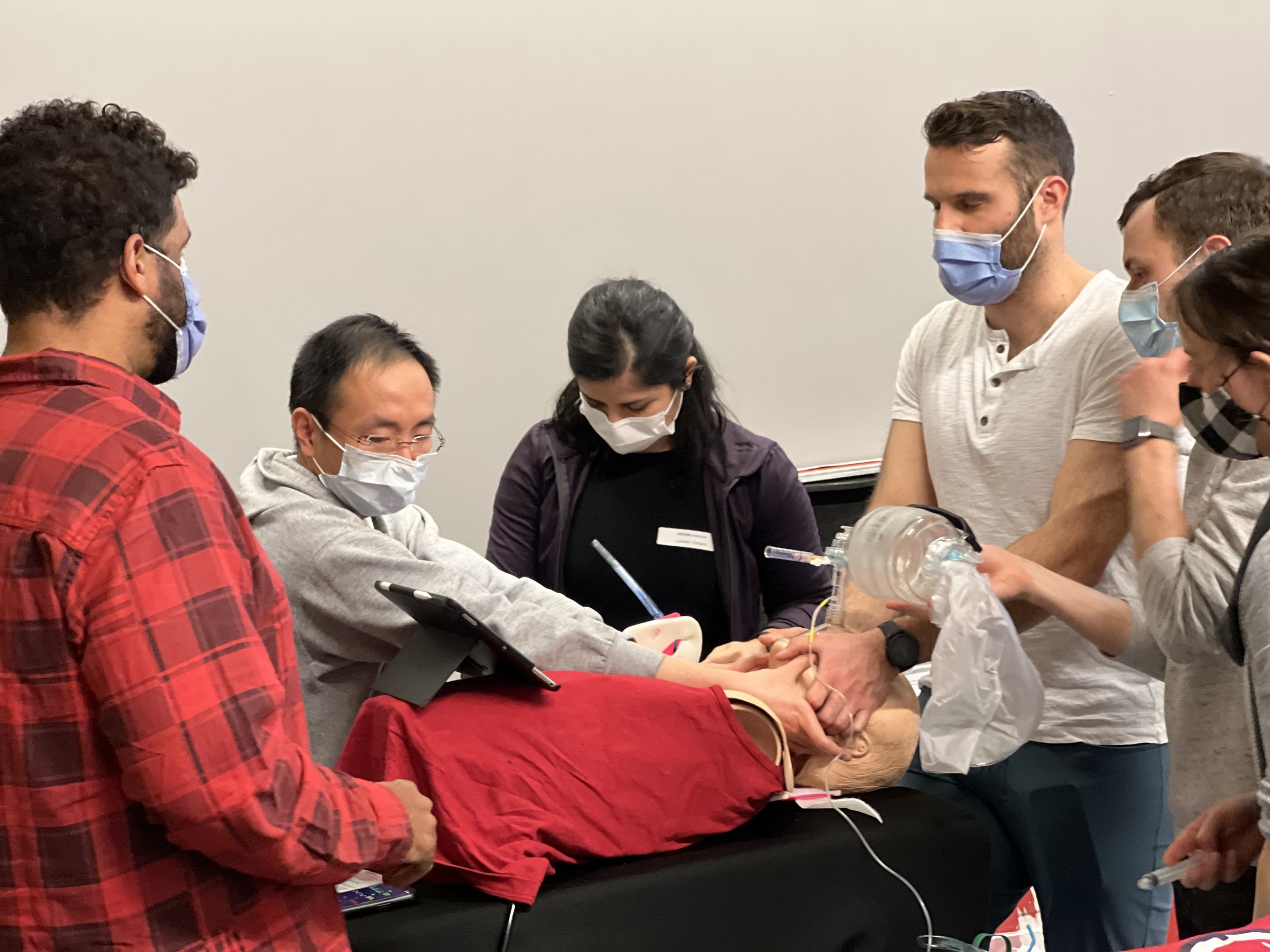
For over 25 years AIME On-the-Road has been providing high value educational support for clinicians in Canada and other regions around the world who are responsible for airway management in emergencies. Management of both the anticipated and unanticpated difficult airway requires evidence-based decision making and skillful procedural execution customized the patient’s presentation and the providers clinical environment. This program uses case-based group discussion with hands-on workshops using commonly available/increasingly accessible airway devices with the goal of enhancing provider confidence and skills that ultimately improve patient outcomes.
-
Case-based decision-making
Patient optimization before airway management
Hyperangulated and Macintosh video laryngoscopy
Awake and rapid sequence intubation approaches
Difficult airway management and rescue ventilation/oxygenation
Cricothyrotomy decision-making and execution
Canadian Airway Focused Group guideline algorithms
Pre-program education materials with customized videos
Small-group learning with 5–6:1 instructor ratios
-
Practice making acute care airway management decisions.
Organize a practical staged approach to airway management.
Choose the most appropriate method of airway management based on a variety of patient presentations.
Choose appropriate pharmacologic agents used to facilitate airway management.
Illustrate when and how to use various tools and adjuncts for managing the difficult airway.
-
Introduction and Oxygenation (0730 breakfast, 0800 start)
Workshop 1: Peri-intubation Oxygenation good lungs bad lungs, BVM & SGA Pearls
Review and Mac Videolaryngoscopy
COFFEE
Workshop 2: Mac Videolaryngoscopy (VL)
Mac VL Review and Hyperangulated Video Laryngoscopy
Workshop 3: Hyperangulated (HA) VL
HA VL review and intubation approach
LUNCH (on site)
Approach to the Difficult Airway
Workshop 4: Nasal endoscopy/Cricothyrotomy/Awake intubation/SALAD (contaminated airway)
Workshop 5: Case Discussions, Drugs and stuff working Coffee
Workshop 6: Simulation and skill consolidation and practice
Wrap-up / Evaluation (1730-1745)
*Timings (other than start and finish time) and materials subject to change
-
CFPC
This 2 credit per hour Assessment program has been certified by the College of Family Physicians of Canada for up to 22 certified Mainpro+ creditsRCPSC
This event is an Accredited Group Learning Activity (Section 1) as defined by the Maintenance of Certification Program of the Royal College of Physicians and Surgeons of Canada, and approved by CAEP. You may claim a maximum of 11 hours (credits are automatically calculated).This program was developed by AIME Training (ATI) with support from the Canadian Association of Emergency Physicians (CAEP) and was planned to achieve scientific integrity, objectivity and balance.
-
CAEP Members: $1650 (CAD)
Non-members: $1975 (CAD)
Residents: $1450 (CAD)
-
Instructors for AIME are experienced educators and clinicians from across the country.