
Programs
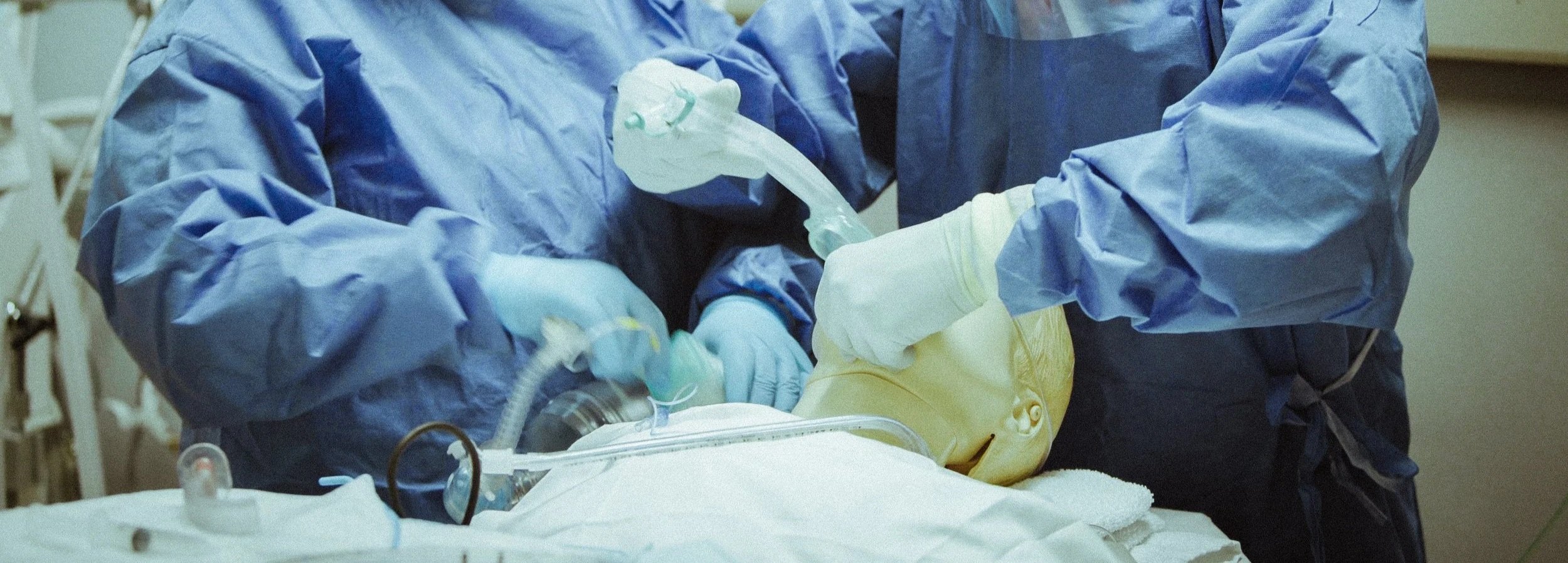
Develop the skills and judgment required for safe, effective airway management in critical settings. Our programs offer advanced, hands-on education designed to strengthen clinical decision-making in airway emergencies.
Learn, do, repeat.
For more than two decades, the Airway Interventions & Management in Emergencies (AIME) programs have equipped clinicians with practical, hands-on training in emergency airway management. Each course is designed with real-world practice in mind, offering immersive learning experiences that prepare physicians to confidently manage high-stakes airway scenarios.
AIME Advanced | Clinical Cadaver
A Hands-on, Advanced Airway Learning Experience Using Clinical Cadavers
For experienced clinicians with prior airway training (AIME, residency, or significant clinical experience). Uses cadavers donated to Dalhousie’s Human Body Donation program for unparalleled realism.
-
5:1 learner-to-instructor & cadaver ratio
Core airway skills reinforced using open lung windows
Repetitive practice to improve first-pass success with multiple video laryngoscopes
Case-based simulation and provider experience sharing
Practice advanced techniques including flexible nasal endoscopy and cricothyrotomy
-
Optimize oxygenation and ventilation with real-time feedback
Reinforce best practices in video laryngoscopy
Refine laryngoscopy skills with rapid cycling practice
Apply strategies to difficult airway management in unconscious patients
Explore decision-making for anticipated difficult airways
Perform advanced airway interventions in cadaver-based simulations
-
Intro and patient preoxygenation updates
Workshops on Mac and Hyperangulated VL
Flexible nasal endoscopy practice
Fireside case discussions
Simulation-based rapid-cycle airway practice
Surgical airway workshop and wrap-up
AIME Awake | Clinical Cadaver
A Hands-on, Skill-Focused Advanced Airway Learning Experience Using Clinical Cadavers
Designed for experienced clinicians with prior airway management training or significant field experience. This course uses clinical cadavers donated to the Dalhousie Human Body Donation program, offering unmatched anatomical fidelity.
-
5:1 learner-to-instructor & cadaver ratio
Review current guidelines on awake tracheal intubation (ATI)
Practice topicalization techniques for ATI
Repetitive practice in oral and nasal flexible endoscopic intubation
Video laryngoscopy–assisted ATI training
Case simulations and group discussions
-
Recognize indications for ATI through airway evaluation
Perform topical airway anesthesia for ATI
Gain hands-on experience with flexible endoscopy and video laryngoscopy
Practice awake airway assessment techniques
Explore real-world case conundrums and solutions
Build confidence in performing ATI when indicated
-
Didactic intro to ATI
Hands-on sessions in topicalization, oral/nasal ATI, and video laryngoscopy
Case simulations and scenario-based consolidation
Wrap-up and cognitive consolidation
AIME On-the-Road
A Hands-on, Case-Based Practical Airway Learning Experience
Physicians working in acute care settings who manage patients requiring emergency airway intervention. Instructors are practicing clinicians—not industry representatives—who understand diverse practice environments.
-
Case-based decision-making
Patient optimization before airway management
Hyperangulated and Macintosh video laryngoscopy
Awake and rapid sequence intubation approaches
Difficult airway management and rescue ventilation/oxygenation
Cricothyrotomy decision-making and execution
Canadian Airway Focused Group guideline algorithms
Pre-program education materials with customized videos
Small-group learning with 5–6:1 instructor ratios
-
Improve confidence in acute care airway decisions
Optimize patients before airway management
Apply a staged approach to airway management
Choose appropriate intubation methods for varied presentations
Use pharmacologic agents effectively in airway management
Employ adjuncts and tools for the difficult airway
-
Introduction & oxygenation
Workshops: peri-intubation oxygenation, Mac video laryngoscopy, hyperangulated VL
Case discussions, drugs, and contaminated airway scenarios (SALAD)
Nasal endoscopy, awake intubation, and cricothyrotomy
Simulation-based integration and wrap-up