
Programs
Develop the skills and judgment required for safe, effective airway management in critical care settings. Our programs offer advanced, hands-on education designed to strengthen clinical decision-making in airway emergencies.
Learn, do, repeat.
For more than two decades, the Airway Interventions & Management in Emergencies (AIME) programs have equipped clinicians with practical, hands-on training in emergency airway management. Each course is designed with real-world practice in mind, offering immersive learning experiences that prepare physicians to confidently manage high-stakes airway scenarios.
AIME Awake Program
Making awake tracheal intubation a real option for managing the anticipated difficult airway in patient’s requiring emergency airway management
Guidelines for airway management in patients with an anticipated difficult airway universally include the option of performing an ‘awake’ tracheal intubation (ATI). Performing a rapid sequence intubation (RSI) using video laryngoscopy has become a standard approach to facilitate tracheal intubation for airway management in emergencies, whereas experience in performing ATI is limited. Awake tracheal intubation however remains a necessary alternative to RSI in not only anticipated anatomically difficult airway cases, but also for selected physiologically compromised apnea intolerant patients. This program provides attendees with with an approach and the skills necessary to safely perform ATI when indicated. Instructors from Emergency Medicine and Anesthesiology along with specially prepared clinical cadavers provide an unparalleled unique high fidelity skills learning experience.
-
This program uses specially prepared Clinical Cadavers
5:1 learner-to-instructor with pragmatic, experienced clinical educators from emergency medicine anesthesiology.
Review decision-making/ indications for awake tracheal intubation (ATI) for management of anatomically and physiologically difficult airway cases.
Practice topicalization techniques for ATI
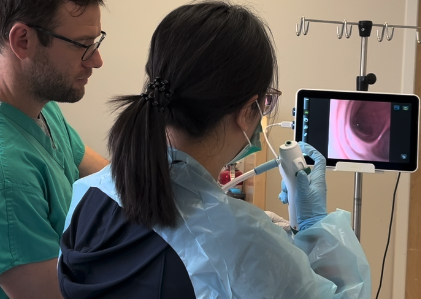
Repetitive practice in oral and nasal flexible endoscopic intubation
Video laryngoscopy–assisted ATI training.
Learn-do-repeat rapid cycle deliberate practice to consolidate learning and maximize exposures.
Group discussions opportunities to review cases and address challenges clinician’s may encounter in their unique work environment.
-
Based on airway evaluation, indicate when ATI is the safest option for securing the airway.
Identify the components of awake tracheal intubation (ATI).
Communicate with the team and patient in preparation for and during ATI.
Perform effective topical airway anesthesia to facilitate well-tolerated ATI.
Use flexible endoscopy and video laryngoscopy to facilitate tracheal intubation in clinical cadavers.
Recognize when to enhance the standard airway evaluation with awake internal airway assessment and use flexible endoscopy or video laryngoscopy for the purpose.
Identify and manage difficulties that may arise during ATI.
-
0800-0830 Arrival/registration/breakfast
0830-0850 Introduction and review of agenda and program logistics
0850-0930 Didactic: Introduction to awake tracheal intubation (ATI)
0930-1000 Hands-on 1: Topical airway anesthesia for ATI
1000-1020 Coffee break.
1020-1200 Hands-on 2: Oral ATI using flexible endoscopy
1200-1240 Lunch
1240-1320 Hands-on 3: Oral ATI using video laryngoscopy
1320-1400 Hands-on 4: Nasal ATI using flexible endoscopy
1400-1500 Case simulations and discussion (with refreshments)
1500-1600 Hands-on 5: Scenario based consolidation simulation
1600-1630 Cognitive consolidation and wrap-up
*Timings (other than start end finish time) and materials subject to change